
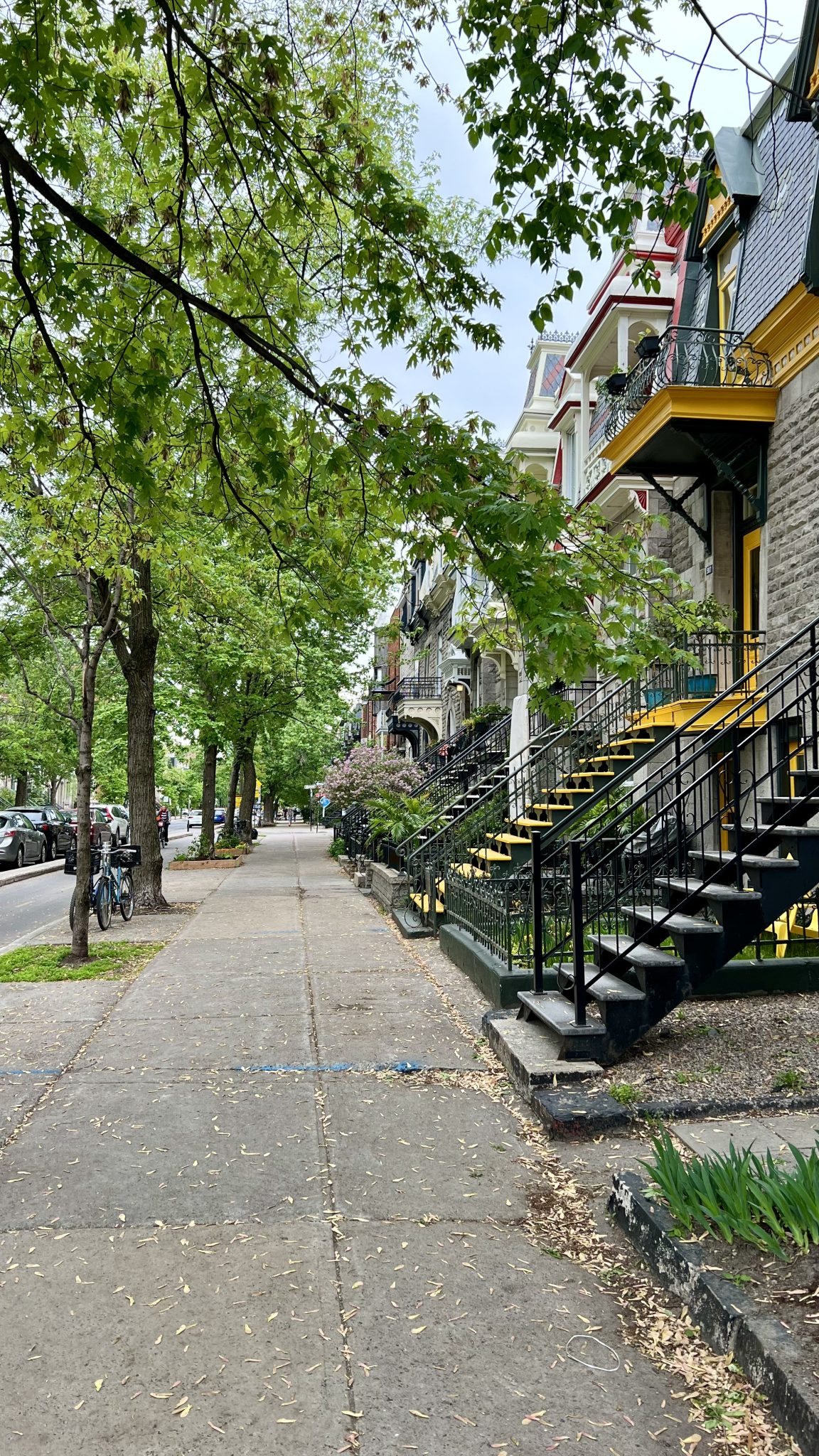
Ask a Montrealer to picture the city and there is a good chance they see the Plateau-Mont-Royal: a row of brick triplexes, wrought-iron spiral staircases curling down to the sidewalk, a maple in front and a lane full of bikes and cats behind. We have lived on, rented on and helped friends move onto the Plateau for years, and the charm is real. So is the price of it. This guide walks through what the neighbourhood actually feels like day to day, what the housing stock is, what it costs as of recent years, and who tends to be happy here.
Where the Plateau begins and ends
The borough of Le Plateau-Mont-Royal sits just north and east of downtown, between the slope of Mount Royal on the west and the railway tracks and Rosemont-La Petite-Patrie to the north and east. Sherbrooke Street marks the southern edge, with the Latin Quarter and Ville-Marie below it. Locals usually split the borough into pieces: the Plateau proper around Avenue du Mont-Royal, Saint-Denis and Parc La Fontaine; Mile End to the northwest around Saint-Viateur and Bernard; and the quieter blocks east of Papineau that shade into what people still call the “Plateau Est” or simply Rosemont’s doorstep.
Getting around without a car is the whole point of living here. The Orange line runs under Berri and Saint-Denis with stations at Sherbrooke, Mont-Royal and Laurier, and the 55 bus on Saint-Laurent and the 80 on Avenue du Parc fill in the west side. Bike lanes on Rachel, Saint-Urbain, Clark and Boulevard Saint-Joseph are among the busiest in the city, and the borough has been narrowing streets, adding one-way sections and planting curb extensions for more than a decade.
The triplex, explained
The signature building of the Plateau is the “plex”: a two- or three-storey walk-up with one apartment per floor, built mostly between about 1890 and 1930 when the area filled with francophone, Jewish and later Portuguese working families. The ground floor is usually reached from a small stoop; the upper units get their own front door via the famous exterior staircase, an arrangement that saved interior space and heating costs in an era when every square foot mattered. Inside, the classic layout is a long, narrow “shotgun” plan: a double parlour at the front, bedrooms along a corridor, and a kitchen at the back opening onto a balcony or a shed over the lane.
Renovated units keep the good parts, such as ten-foot ceilings, plaster mouldings, hardwood floors and original woodwork, and fix the bad ones, mainly plumbing, wiring, insulation and the notorious flat roofs. Unrenovated ones exist too, and they are how many people can still afford the area. If you are buying, budget for a proper inspection: rubble-stone foundations, old wiring and shared party walls are all normal here.
What it costs, as of recent years
The Plateau stopped being cheap a long time ago. As of recent years, a whole triplex in decent condition on a good street typically trades somewhere between roughly 1.3 and 2.2 million dollars, with Mile End and anything close to Parc La Fontaine at the top of that range. Condominiums carved out of plexes, usually a single floor of 900 to 1,300 square feet, tend to sit in the 550,000 to 900,000 dollar band depending on finish, outdoor space and whether there is a parking spot, which is rare. Semi-detached single-family houses are scarce and command a premium.
Renting is where most newcomers start. A classic “4 1/2”, meaning two bedrooms plus living room and kitchen in Quebec shorthand, generally rents in the 1,700 to 2,600 dollar range as of recent years when it comes back on the market, and larger 5 1/2 and 6 1/2 units with a balcony or lane access can go well beyond that. Long-term tenants under Quebec’s rent-control framework often pay far less, which is why so many leases here are handed from friend to friend rather than advertised. July 1st, the traditional moving day, is when the streets fill with trucks and the best units move fast.
Lanes, parks and the daily routine
The lanes, or “ruelles”, are the Plateau’s second street network. Originally service alleys for coal and ice deliveries, many have been converted into “ruelles vertes”, green lanes closed to through traffic, painted with murals and planted by residents. Kids learn to ride bikes in them, neighbours host block parties, and a unit with a lane entrance is a genuine selling point. Parc La Fontaine, with its two ponds, outdoor theatre and skating in winter, is the borough’s living room; Parc Jeanne-Mance faces the mountain and hosts the Sunday tam-tams at the George-Etienne Cartier monument in warm weather; smaller parks like Parc Laurier with its outdoor pool anchor the blocks in between.
Shopping is almost entirely on foot. Avenue du Mont-Royal runs the full width of the borough with fruit stores, bakeries, bookshops, cafes and the bars that give the street its evening buzz; Saint-Denis has recovered from a rough patch with new restaurants and a permanent bike path; Saint-Laurent carries the Portuguese grocers and the late-night crowd; Bernard and Saint-Viateur in Mile End are bagel and coffee territory. The residential streets between them are surprisingly quiet.
Who lives here, and who should
The borough is dense, young and francophone by majority, with a strong minority of anglophones, allophones and students from the universities downtown and on the mountain. Public schools include several French elementary schools within walking distance of most blocks, English-board options nearby, and a dense web of daycares, the CPE network, which fills up quickly and is worth registering for early. The CLSC and local clinics are on the main streets, and the CHUM and the Jewish General are a short ride away.
The Plateau suits people who value time over space: couples and singles who want to walk to work, families who accept a smaller apartment in exchange for a park across the street, and anyone who likes noise, festivals and a sidewalk cafe more than a driveway. It suits less well those who need to park a car every night, want a garage or a yard, or prefer new construction with an elevator. Winter is the true test: shovelling a spiral staircase in freezing rain is a rite of passage.
Our honest verdict
The Plateau is expensive because the things that make it good, walkable density, historic housing, parks, transit and culture, are all in short supply elsewhere and cannot be built quickly. If your budget stretches to it, a well-kept plex condo or a long-term lease here is one of the surest ways to enjoy Montreal as it is meant to be lived. If it does not, the neighbouring streets of Rosemont, Villeray and Hochelaga offer much of the same architecture for noticeably less, and we cover each of them elsewhere on this site.