
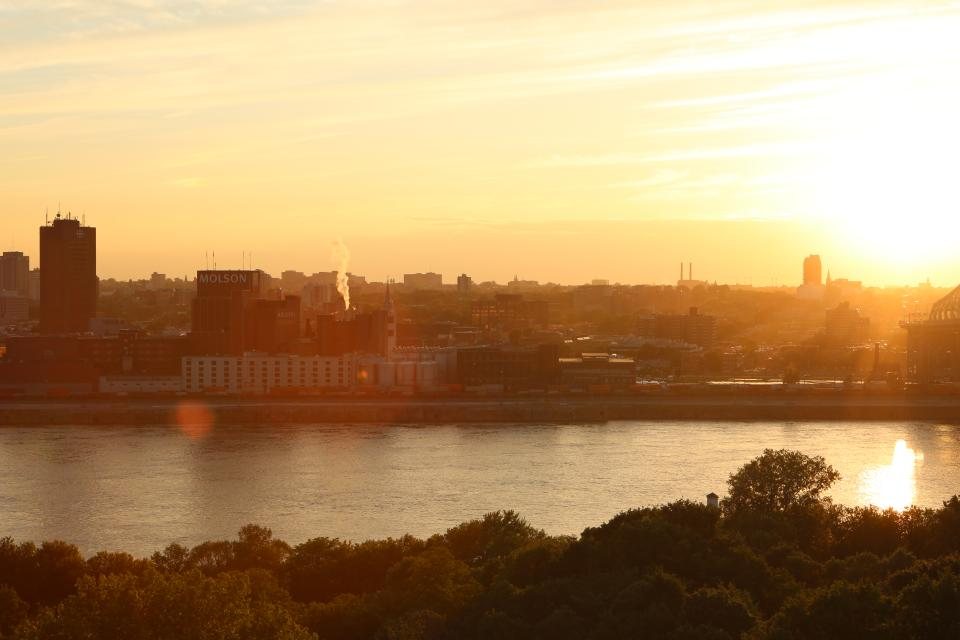
For most of the twentieth century, Verdun was the working-class town downriver from the city, a place of brick duplexes, hockey rinks and a strict tradition of no bars on the main street. It merged into Montreal in 2002, and over the following two decades it changed faster than almost any other borough on the island. Today the river path is full of joggers, Wellington Street has become one of the most talked-about commercial strips in Canada, and the same duplexes that sold for a song in the 1990s are the object of bidding wars. We have watched the transformation up close, and this guide lays out what Verdun offers now, what it costs, and what has been lost and gained along the way.
A borough shaped by the river
Verdun occupies the southwest shore of the island, wedged between the Saint Lawrence River, the Lachine Canal and the Aqueduct Canal, with the Sud-Ouest borough to the north and LaSalle to the west. It is compact and easy to read: a long grid of residential streets running from the river up to Boulevard LaSalle and Verdun Avenue, with Wellington Street as the commercial spine and the Green line running underneath it. The borough also includes Nuns’ Island, or Ile-des-Soeurs, the planned mid-century community across the Champlain Bridge approach that feels like a different city and deserves its own guide.
The river is the reason people move here. A continuous park and bike path follows the shoreline from the Sud-Ouest all the way to LaSalle, past the Verdun Auditorium, the 1940s Natatorium outdoor pool, and since 2019 an actual urban beach, the Plage de Verdun, where residents swim in the river on summer afternoons. Winter brings cross-country ski tracks along the same stretch and the wind off the water that makes Verdun feel a few degrees colder than the Plateau.
Getting in and out
Three Green line stations serve the borough: Verdun, De l’Eglise and LaSalle, which puts downtown roughly fifteen minutes away and the Plateau under half an hour. Buses on Wellington, Verdun Avenue and Boulevard LaSalle connect the rest, and the bike path along the Lachine Canal offers a flat, car-free ride to Old Montreal and Atwater Market in about twenty minutes. Drivers have easy access to the Champlain Bridge and Highway 15 toward the South Shore, which is one reason Verdun attracts people who work off-island. Parking on the residential streets is tighter than it looks, especially near Wellington, and winter snow-removal rules take newcomers a season to master.
What the houses look like
Verdun’s housing stock was built largely between about 1905 and 1950, in a tighter, plainer version of the Montreal plex. Duplexes and triplexes with exterior staircases dominate the older streets closest to the river and to De l’Eglise; further west and north, the buildings shift to the interior-stair, semi-detached style of the 1930s and 1940s, and in the Crawford Park area at the western tip there is a pocket of small wartime houses with yards. Ceilings are a little lower than on the Plateau and the woodwork simpler, but the layouts are practical, the brick is solid and the lots often come with a real backyard, which is rarer than it sounds in central Montreal.
Two trends have changed the streetscape. The first is renovation: many units have been gutted and rebuilt with open kitchens, added skylights and rooftop terraces, and a whole lane of restored balconies in the same summer is not unusual. The second is new construction, mostly along the river side of Boulevard LaSalle and around the former industrial sites near the Lachine Canal, where mid-rise condo buildings have filled in vacant lots.
Prices and rents, as of recent years
Verdun’s prices roughly doubled over the 2010s and kept climbing into the early 2020s. As of recent years, a duplex in decent condition typically sells for somewhere between 800,000 and 1.3 million dollars, and a triplex a step above that, with the blocks between Wellington and the river carrying the strongest demand. Divided condos in plexes, generally 700 to 1,100 square feet, tend to run in the 400,000 to 650,000 dollar range, and units in the newer riverside buildings can go higher. Older, unrenovated apartments still surface at the lower end and sell quickly, often to buyers planning to live upstairs and rent the ground floor to cover the mortgage.
Rents followed the same curve. A two-bedroom 4 1/2 lists in roughly the 1,400 to 2,100 dollar range as of recent years, and larger family units above 2,000. Long-term tenants pay considerably less, and the borough has a strong network of tenant organizations that reflects how sensitive the question of displacement has become. Anyone renting here should know their rights under Quebec’s rental board and read the lease clause that shows the previous rent.
Wellington Street and the daily round
Wellington is the story everyone tells. For decades it was a modest strip of dollar stores and diners, dry by local bylaw until the mid-2010s. Over about ten years it filled with cafes, bakeries, microbreweries, restaurants and independent shops, the borough pedestrianized a long stretch of it in summer, and in 2022 a well-known international travel magazine named it the coolest street in the world. The hype has cooled, but the street works: it is where Verdun buys bread, meets for a drink and takes visiting parents.
Beyond Wellington, the borough is well served for a family. There are several French and English public elementary schools, a French high school and an English one, a good number of daycares, the Verdun Hospital on Boulevard LaSalle, a CLSC, two arenas and a well-used library and cultural centre. Parks are everywhere, and most are a short walk from any door: Parc Arthur-Therrien with its sports fields, Parc de l’Honorable-George-O’Reilly on the river, and the string of small squares between the streets.
Who should look at Verdun
Verdun suits people who want the river, the space of a backyard and a quieter evening than the Plateau, and who accept that the trade-off is a fifteen-minute metro ride to almost everything else. It has become a natural landing spot for young families priced out of the Sud-Ouest and the Plateau, for cyclists and rowers who plan their week around the water, and for South Shore commuters who want a city address near the bridge. We would only warn you about two things: the wind in January, and the speed at which the good listings disappear.