
Hochelaga-Maisonneuve, or HoMa to the people who market it and simply Hochelaga to the people who have always lived there, is the east-end neighbourhood that Montreal has been arguing about for fifteen years. It has the Olympic Stadium on one edge and the port on the other, some of the most beautiful public buildings in the city and some of the deepest pockets of poverty, a lively main street and a rent map that has changed faster than many residents could follow. We have friends who bought here early and friends who were pushed out, and this guide tries to describe the neighbourhood as it is now: what it offers, what it costs as of recent years, and what a newcomer should understand before moving in.
Where it is and how it is laid out
The neighbourhood is the western half of the borough of Mercier-Hochelaga-Maisonneuve, roughly bounded by the railway tracks and Ville-Marie’s Centre-Sud to the west, Sherbrooke Street and Rosemont to the north, Viau Street and Mercier to the east, and Notre-Dame Street and the Port of Montreal to the south. Historically it was two towns: Hochelaga, annexed by Montreal in 1883, on the western side, and Maisonneuve, an independent industrial city until 1918, on the eastern side, where an ambitious council built a set of grand public buildings in the City Beautiful style before going bankrupt.
The Green line runs the length of the neighbourhood with four stations: Prefontaine, Joliette, Pie-IX and Viau, plus Frontenac at the western boundary. Downtown is about fifteen minutes from Joliette. Buses run on Ontario, Sainte-Catherine, Pie-IX and Notre-Dame, and the Pie-IX bus rapid transit corridor now links the neighbourhood north to Saint-Michel and Montreal North. Cycling is easy on the flat grid, with lanes on Rachel, Bennett and along Notre-Dame toward downtown, though the truck traffic feeding the port makes Notre-Dame itself an unpleasant ride.
The Maisonneuve legacy
The old city of Maisonneuve left the neighbourhood its landmarks. The Maisonneuve Market building of 1914, a beaux-arts hall with a fountain in front, now houses cultural activities while the working farmers’ market operates next door year-round. The Bain Morgan public bath of 1916, still an operating pool, and the Maisonneuve public library, housed in the former city hall, stand near Parc Morgan, a formal park that runs down to Notre-Dame Street. Just north, across Sherbrooke, the Olympic Park holds the stadium, its inclined tower, the Biodome, the Planetarium and the sports centre with its pools, and the Botanical Garden lies beside it. Living within walking distance of that cluster is one of the neighbourhood’s quiet privileges, and the Olympic Park’s outdoor esplanade has become a well-used gathering space in summer and winter.
Housing: triplexes and old factories
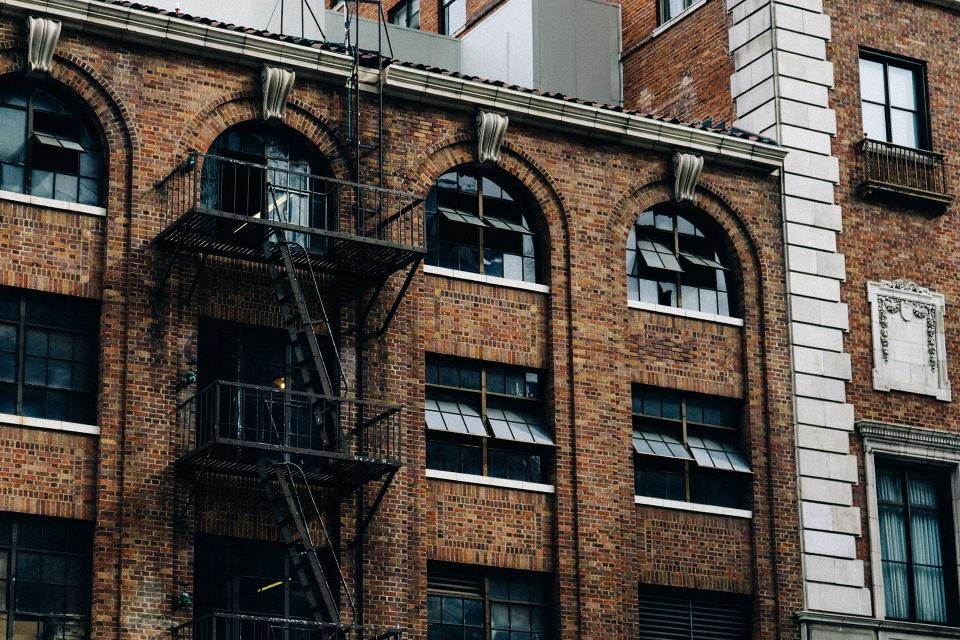
Hochelaga-Maisonneuve was built between about 1880 and 1930 for the workers of the shoe, textile, sugar, biscuit and shipbuilding plants along the river, and it kept its housing when the plants closed. The stock is the Montreal plex in its most economical form: two- and three-storey brick triplexes with exterior staircases, narrow lots, small backyards and long lanes, with a few streets of greystone and a good number of six-plexes on the corners. Ceilings are high, the woodwork is often intact, and units that were never renovated still exist in numbers, which is why the neighbourhood has been a landing spot for artists, students and young families for two decades.
Several former factories have been converted to lofts and condos, particularly along Ontario, Sainte-Catherine and the western edge near Moreau Street, and new mid-rise buildings have filled in vacant lots. The blocks between Ontario and Sherbrooke, and the streets around Parc Morgan and Maisonneuve Market, were renovated first; the blocks south of Sainte-Catherine and toward the port, and the far western streets near Frontenac, came later and still carry the most unrenovated stock.
Prices and rents, as of recent years
Hochelaga-Maisonneuve was the cheapest central neighbourhood in the city until the early 2010s and is no longer, though it remains well below the Plateau and Rosemont. As of recent years, a triplex typically sells in a range of roughly 750,000 to 1.3 million dollars, with duplexes and unrenovated buildings below that and the streets near Parc Morgan and the Olympic Park at the top. Divided condos, usually 700 to 1,100 square feet in a plex or a converted factory, generally list between about 350,000 and 600,000 dollars, which is still the entry point for many first-time buyers in the central city.
Rents tell the story of the neighbourhood’s tensions. A two-bedroom 4 1/2 lists between roughly 1,300 and 1,900 dollars as of recent years, and three-bedroom 5 1/2 units from about 1,700 to 2,400, while the neighbourhood still holds a large population of long-term tenants paying far less. Renovictions, repossessions and the conversion of rental buildings have been fought street by street by an unusually organized network of housing committees and community groups, and the borough has some of the strongest tenant advocacy on the island. Newcomers should understand that a low rent here often comes with a landlord’s plan to raise it.
Ontario Street and daily life
The Promenade Ontario, the commercial stretch of Ontario Street East roughly between Darling and Pie-IX, is the main street: a fruit store, bakeries, a cheese shop, microbreweries, a record store, family restaurants and the diners and pawn shops that predate the cafes. It is pedestrianized in summer and hosts street festivals through the warm months. Sainte-Catherine East, once the commercial heart, has been slower to recover and still has vacant storefronts, though restaurants and bars have begun to fill it in.
Services are strong for a neighbourhood of this income mix. There are several French public elementary schools and a high school, an English elementary school, a dense network of daycares and community centres, a CLSC, the Maisonneuve-Rosemont Hospital a short bus ride north, and libraries, pools and arenas inherited from the borough’s earlier generosity. Parks are plentiful: Parc Morgan, Parc Lalancette with its pool and rink, the sports fields at Parc Champetre, and the Olympic Park itself.
Our take
Hochelaga-Maisonneuve is the last central neighbourhood where a plex with a lane, a market and a metro station is still within reach of a middle-income buyer, and it offers cultural institutions that no other east-end district can match. It is also a place where change has real costs, and living here well means joining the neighbourhood rather than replacing it. If you want the architecture of the Plateau, the market life of Villeray and prices that were the Plateau’s fifteen years ago, and you can respect the people who were here first, this is the neighbourhood we would send you to.