
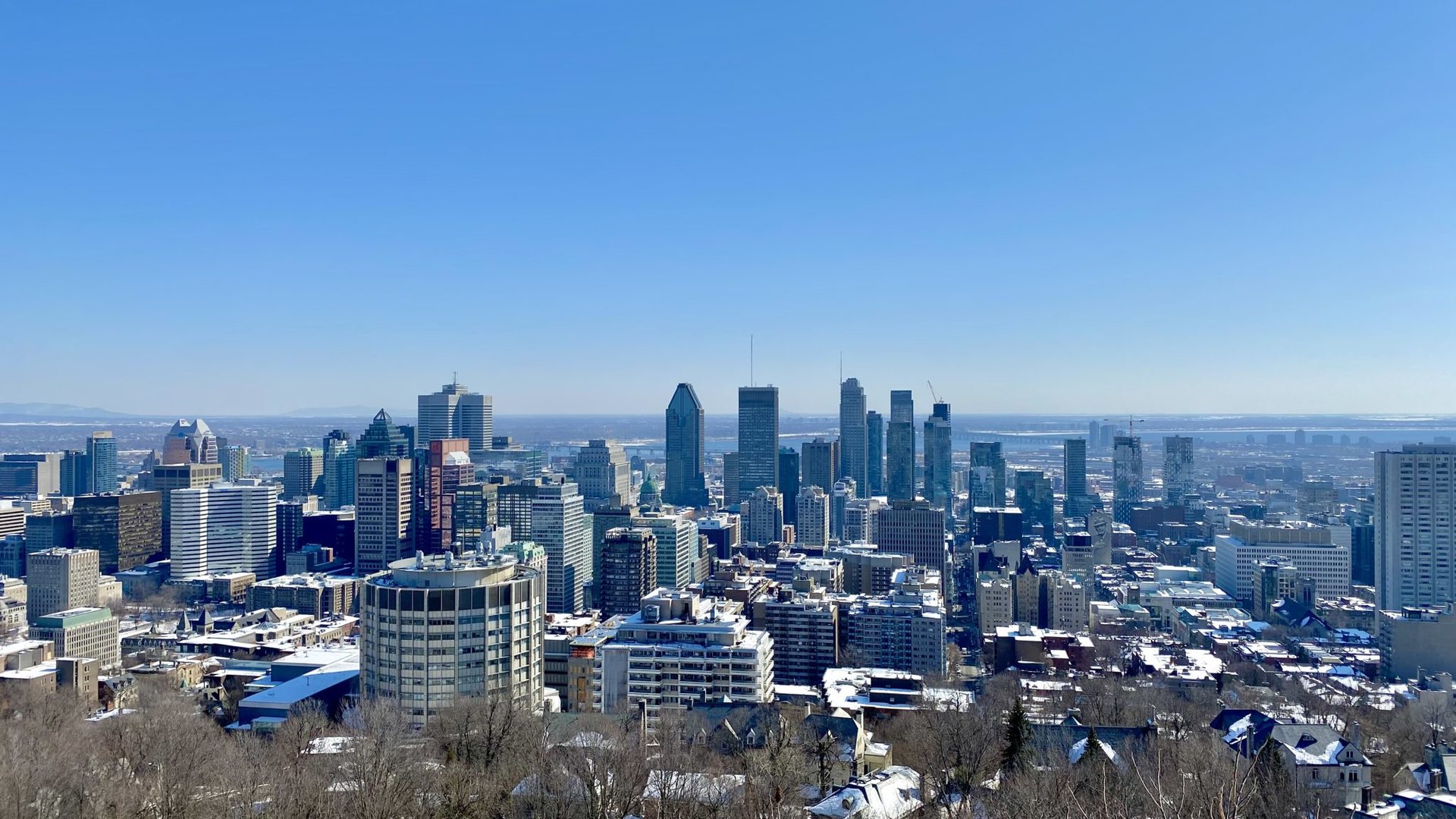
Montreal is an island in a river with a small mountain in the middle of it, and that geography shapes daily life more than newcomers expect. Within a short bike ride of almost any apartment there is a forested hill, a canal, a riverbank, a public beach or a park large enough to lose yourself in. The city counts more than a thousand parks and green spaces, and Montrealers use them hard in every season, from a July picnic to a February ski. Here is where we go, and how the outdoor year unfolds.
Mount Royal, the mountain
Everyone calls it the mountain, though its summit is only 233 metres above sea level. Mount Royal Park was laid out in the 1870s by the same landscape architect who designed Central Park in New York, and it remains the city’s shared backyard. A wide gravel carriage road climbs gently from the eastern foot to the chalet and the Kondiaronk lookout, which delivers the classic postcard view of downtown, the river and the hills beyond. Beaver Lake, an artificial pond on the western shoulder, is the hub for family activities: paddle boats in summer, a refrigerated skating rink and a tube-sliding hill in winter. Steeper footpaths and stairways thread through the woods from the Plateau and from the university campuses on the south side, and runners, walkers and dog owners fill them at every hour. On Sunday afternoons from spring to autumn, the lawn at the eastern entrance around the monument becomes the tam-tams, an informal drumming circle that has gathered for decades, with hundreds of drummers, dancers, vendors and a weekly medieval-style foam-sword battle nearby. It is loud, joyful and completely free.
The Lachine Canal and the riverbanks
The Lachine Canal runs about fourteen kilometres from the Old Port southwest to Lake Saint-Louis. It opened in 1825 to bypass the rapids, powered the industrial heart of Canada for a century, closed to shipping in 1970 and reopened as a national historic site and recreational waterway. Today its towpath is the busiest bike path in the city, a flat, car-free route past former factories turned into lofts, the Atwater Market, locks and quiet stretches of water where kayakers and paddleboarders drift on summer evenings. At the western end the path continues along the lakeshore through Lachine, where the setting sun over the water is one of the island’s underrated sights. On the river’s other faces, the Old Port has a promenade, a beach with no swimming, a large ferris wheel and a winter skating rink, while Verdun to the southwest has a long, wild riverside park with the rapids in view and a natural sand beach that opened a few years ago and is now packed on hot days.
Parc Jean-Drapeau and the islands
Two islands in the river, reachable by metro in a few minutes from downtown, form Parc Jean-Drapeau. Sainte-Helene Island was the site of the 1967 world’s fair, and its geodesic dome survives as an environmental museum. Notre-Dame Island next door was built from the excavated rock of the metro tunnels. Between them they offer an outdoor aquatic complex with three pools, a sandy beach on a filtered lagoon, a rowing basin, gardens, an amusement park and the motor-racing circuit that, outside race weekend, is open to anyone on a bicycle, rollerblades or running shoes. A full lap on smooth asphalt with the skyline across the water is one of the best free workouts in the city. In winter the islands host cross-country ski trails, snowshoe loops and a snow village, and the summer weekends bring some of the biggest outdoor music festivals in the country.
Neighbourhood giants: Jarry, Maisonneuve, La Fontaine
Beyond the mountain and the river, each part of the island has a large park that functions as its living room. Parc Jarry in Villeray, in the north, is a wide green rectangle around a tennis stadium that hosts an international tournament every summer. It has a pond, a skate park, cricket pitches used by the South Asian community, an outdoor pool and enough lawn for a thousand simultaneous picnics. Parc Maisonneuve in the east sits beside the Olympic Stadium and the botanical garden, and its rolling open fields are the best in the city for kite flying in summer and for sledding and cross-country skiing in winter, when the groomed trails loop through the park and around the neighbouring golf course. Parc La Fontaine in the Plateau is smaller but more intensely used: two ponds joined by a small waterfall, an outdoor theatre, a wading pool, and in winter, when the cold cooperates, a skating surface on the ponds that turns the whole park into a village fair. Angrignon in the southwest and the string of nature parks along the northern shore of the island round out the list.
Winter outdoors: skiing and skating in the city
The city grooms cross-country ski trails inside the urban parks as soon as the snow base allows, usually from late December to early March. Mount Royal has a network of gentle loops, Maisonneuve has longer flat circuits, the islands have trails with river views, and the big nature parks at the western and northern tips of the island offer the closest thing to a countryside ski without leaving the city. Rentals are available at the mountain and at several of the parks. Skating is even more widespread: nearly every borough maintains outdoor rinks, some of them refrigerated so that they run regardless of the weather, and the Old Port and Beaver Lake rinks are the scenic ones. Sledding hills, snowshoe loops and a handful of fat-bike trails complete the winter offer. The main rule is to check conditions before you go, because a thaw can close a trail overnight.
Swimming spots and the summer water
Summer in Montreal is hot and humid, and the city responds with water everywhere. Every borough runs free outdoor pools and wading pools from late June to late August, with the larger ones in Jarry, Jean-Drapeau and Maisonneuve drawing crowds on heat-wave days. For actual beaches, there is the lagoon on Notre-Dame Island, the river beach in Verdun, the beach at the nature park on the far western tip of the island, and a beach on the lake at the northwest end. Water quality in the river is monitored and posted, and the best swimming days are usually a couple of days after a dry spell. Surfers ride a permanent standing wave on the river below the Old Port, kayak and paddleboard rentals dot the canal and the islands, and the rapids at Lachine are run by whitewater rafting outfits. For a city that spends four months under snow, Montreal knows how to spend the other eight outside.