
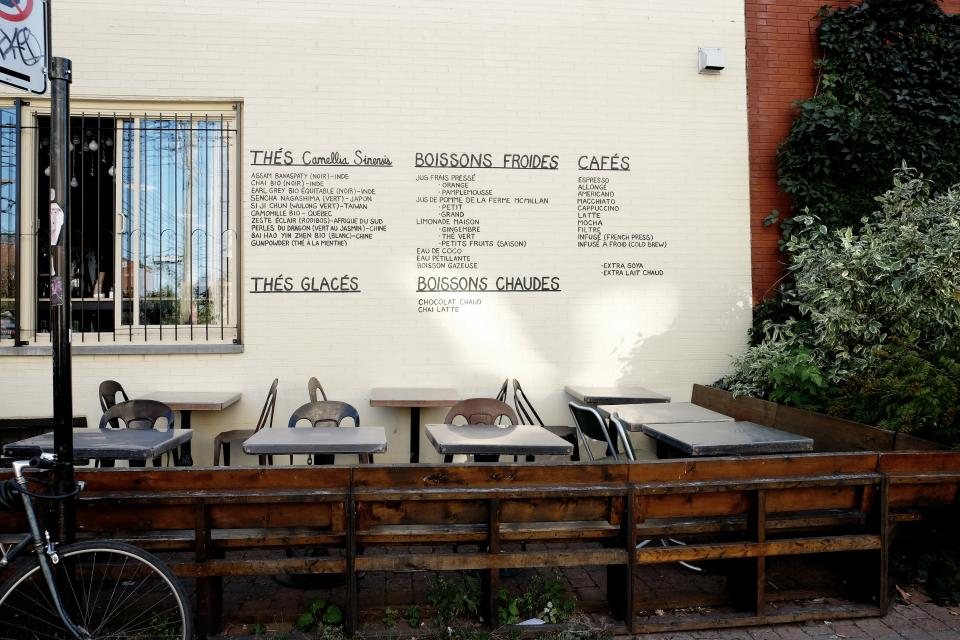
Montreal is the largest French-speaking city in the Americas and, at the same time, one of the most bilingual cities anywhere. Around six in ten people on the island can hold a conversation in both French and English, and hundreds of thousands speak a third language at home. That mix is the daily texture of the place: you will hear a conversation switch languages mid-sentence in a bakery, and you will see a job posting that asks for both without anyone thinking it odd. For a newcomer, especially one arriving from an English-speaking country, the question is not whether you need French but how much, how fast, and where it matters most. We have lived on both sides of the linguistic line and here is our honest map.
The linguistic landscape, neighbourhood by neighbourhood
The old rule of thumb was that Saint-Laurent Boulevard, the Main, divided a French east from an English west. It is a simplification, but it still explains a lot. East of the boulevard, in Rosemont, Hochelaga, Villeray and the boroughs beyond, French is the language of the street, the shops and the schoolyard. Head west through Westmount, Notre-Dame-de-Grace, Cote-Saint-Luc and on into the West Island, and English becomes the default in stores and among neighbours, although French is never far away. In between sit the mixed zones: the Plateau, Mile End and downtown, where you can live in either language, and the immigrant neighbourhoods of Cote-des-Neiges, Parc-Extension and Saint-Laurent, where French and English share the sidewalk with Arabic, Spanish, Tamil, Vietnamese and a dozen others. The south shore and Laval lean strongly French. Where you choose to live shapes how much French you will use on an ordinary Tuesday.
What the language laws mean for daily life
Quebec’s Charter of the French Language, first adopted in 1977 and strengthened several times since, makes French the official language of the province, of public administration, of the workplace and of commercial signage. You feel it in small ways. Government letters and forms arrive in French, and you are expected to deal with provincial services in French, with some exceptions for those who were already served in English before the most recent reforms. Businesses must be able to serve you in French, and larger employers must run their internal operations in French, which in practice means that many office jobs ask for a working level of both languages. None of this prevents you from speaking English with friends, reading English media, or getting a job in an English-speaking team. It does mean that French is the language of the institutions you cannot avoid: the tax authority, the health-card office, the driver’s licence bureau and the municipal courts.
Signage and the language of the street
Commercial signs in Quebec must be in French, and where another language appears, French must be markedly predominant, meaning larger or given more space. That is why you will see a familiar international chain with a French descriptor added to its name, and why menus always exist in French even when a bilingual version is on the table. Public signs, road signs and transit announcements are in French only, which trips up new arrivals for the first few weeks. A handful of words are worth learning before you drive: arret is stop, sortie is exit, and a sign saying stationnement interdit means you should not park there. Around the metro, correspondance means transfer and the doors close on the word attention.
Schools and the rules for children
This is the part that surprises many families. Public schooling in Quebec is organised in two parallel systems, French and English, and access to the English public system is restricted. In general terms, a child may attend an English public school only if a parent, or a sibling, received most of their elementary education in English somewhere in Canada. Children of newcomers, whether they arrive from France, India, Brazil or the United States, are in most cases required to attend French public school, and the same rule applies to most subsidised private schools. Temporary residents on certain work or study permits can obtain time-limited exceptions. For most immigrant families the result is that the children become fluent in French within a year or two while keeping the home language, and many parents say it turned out to be the best thing that happened to them here. Colleges and universities are not subject to the same restriction, and Montreal has both French-language and English-language institutions at every level.
Learning French as a newcomer
The provincial government runs a free francisation programme for adult newcomers, with full-time and part-time classes offered in person and online, and in some cases a small financial allowance for those who study full time. Registration goes through a single provincial portal and waiting lists can be long in the autumn, so it pays to sign up before you arrive. Beyond the official classes, school boards run evening courses, community organisations offer conversation circles, and there are language-exchange meetups nearly every night of the week. The most effective method, in our experience, is a low-stakes daily habit: order in French at the cafe, listen to local radio in the car, read the free daily newspaper on the metro, and accept that you will be corrected gently and often. Montrealers are generous with learners as long as you try. Starting in English and switching to French when you stumble is fine. Refusing to try is what earns a cold look.
Everyday phrases that carry you a long way
Quebec French has its own rhythm and vocabulary, and a few local expressions will make you sound less like a textbook:
- Bonjour, hi: the classic Montreal greeting in shops, an invitation to reply in either language
- Salut and allo: casual hello among friends and neighbours
- Ca va: how are you, and also the answer, fine
- Un depanneur: the corner store, and depanner means to help someone out of a jam
- C’est correct: it is okay, no problem, said constantly
- Bienvenue: you are welcome, used in Quebec where France would say de rien
- Pas pire: not bad, the local way of saying pretty good
Living bilingually in Montreal is less a policy question than a daily practice. You will speak French to the landlord and English to the plumber, or the other way round, and after a while you will stop noticing which one you are using. That is when the city starts to feel like home.